
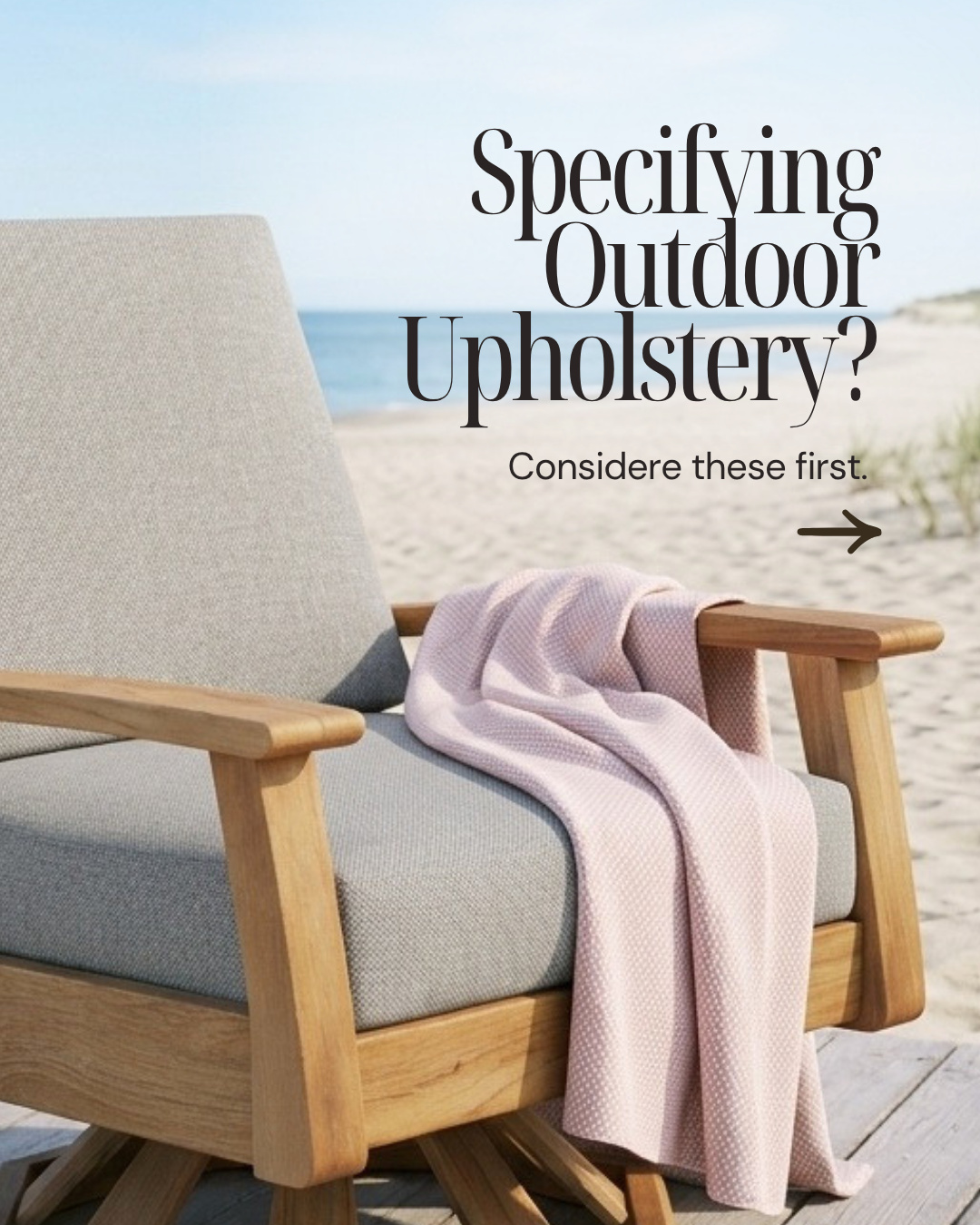
Color is the fun part of an outdoor upholstery spec. It’s also the last decision you should make.
The right fabric and cushion depend on where the furniture lives and who sits on it: sun exposure, moisture, maintenance, and traffic. Settle those four, and the color conversation gets easy. Skip them, and the prettiest swatch in the deck becomes next summer’s phone call.
Here’s how we walk designers and architects through it, plus a checklist to keep at your desk.
“Outdoor” on the Label Is Where the Questions Start
“Outdoor fabric” is a category, not a specification. Two textiles can both carry the word and behave nothing alike after one season.
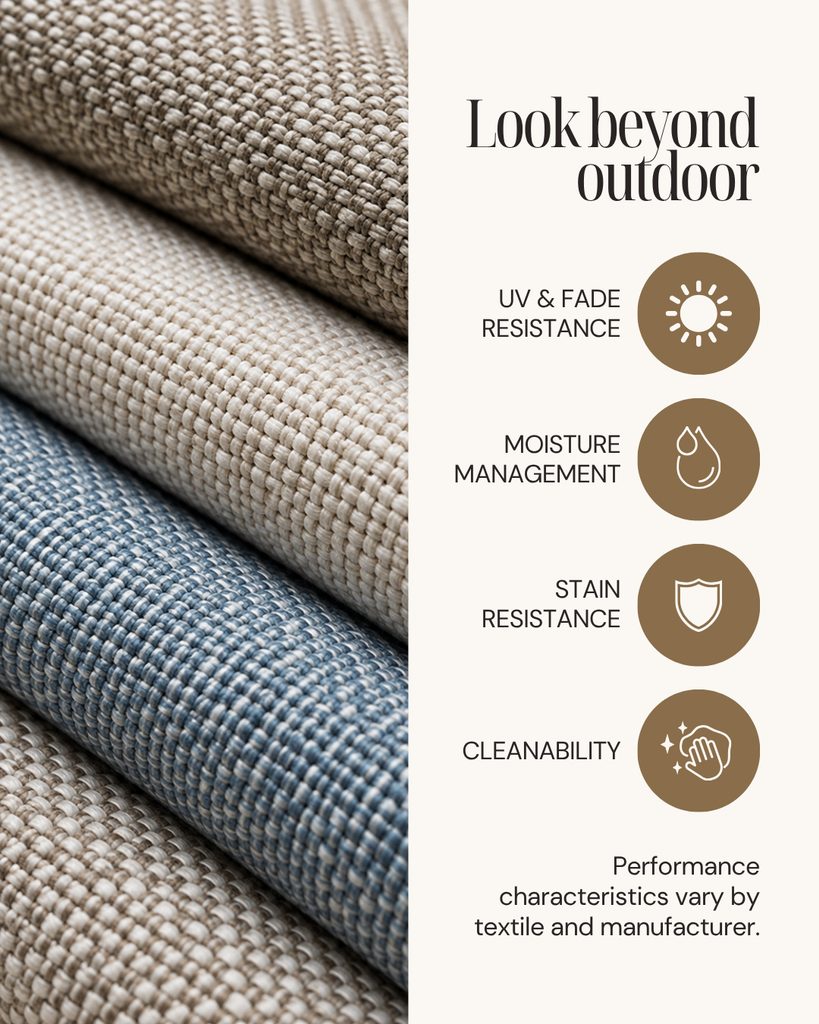
Look past the label to four things:
- UV and fade resistance. How well the color holds in direct sun.
- Moisture management. How the fabric and cushion handle water, and how fast they dry.
- Stain resistance. How well the fabric shrugs off a spill in the first place.
- Cleanability. What it takes to get a stain out once it’s in.
Performance varies by textile and by manufacturer. So the useful question isn’t “is it outdoor?” It’s “outdoor where, and for whom?”
Start With the Sky: Full Sun, Shade, Covered, or Exposed
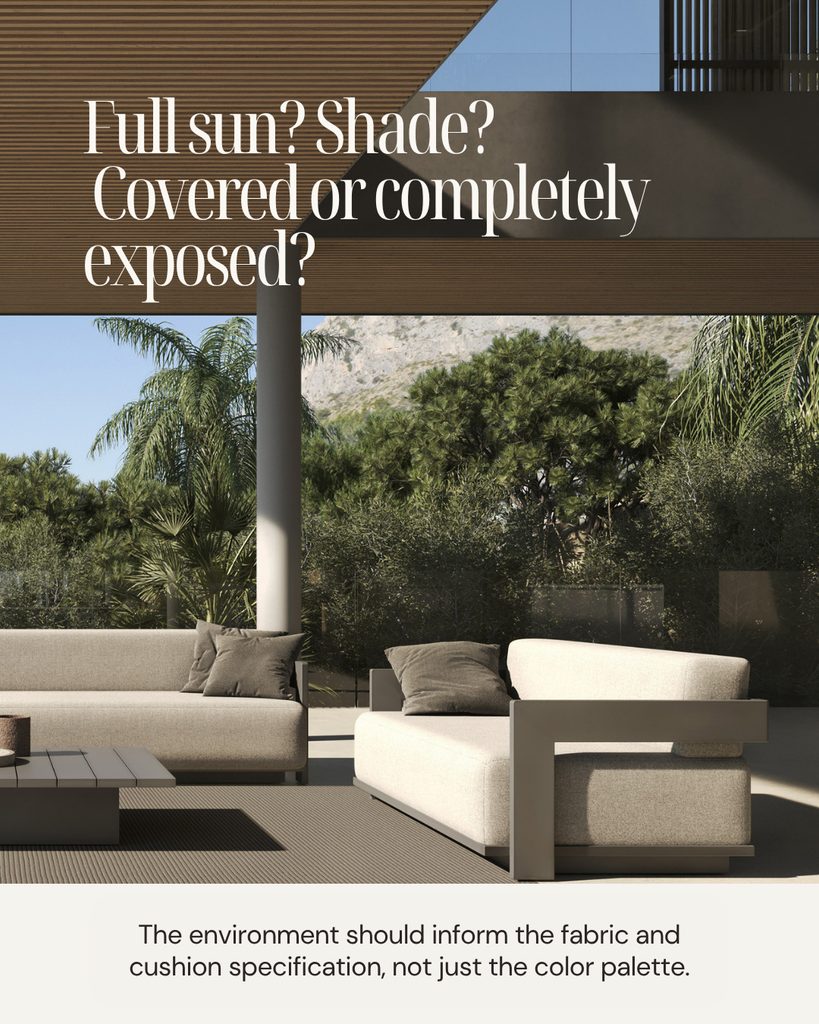
Stand on the site before you open a fabric book. Where does the sun land at 3 p.m.? What’s overhead, and what blows in sideways?
Full Sun Asks the Most of Color
Sun fades dye. The fabrics that hold color best are solution-dyed, which means the pigment goes into the liquid polymer before it ever becomes a fiber. The color runs all the way through, like a carrot, instead of sitting on the surface like a radish.
The test standards show how far apart indoor and outdoor are. The Association for Contract Textiles sets its indoor upholstery lightfastness guideline at 40 hours of light exposure. Its outdoor upholstery guideline calls for 1,000 hours.
One caution from ACT itself: test hours don’t convert to hours in the field. Use the numbers to compare fabrics. Use the site to make the call.
Shade and Cover Change the Problem
Shade is kind to color and hard on drying. A cushion under a deep overhang or a tree canopy stays damp longer, and even a weather-ready fabric can mildew if it sits wet.
Covered doesn’t mean protected, either. A roofed dining terrace still gets wind-driven rain, morning moisture, and temperature swings. In the Northwest, plan for that even when the drawings show a roof.
The Fabric Is Half the Spec. The Cushion Is the Other Half.
A swatch tells you nothing about what’s inside the cushion. What’s inside decides whether your client sits down dry the morning after it rains.
Ask about the fill first. Quick-dry foam has an open, net-like cell structure that lets water run through instead of staying trapped. That’s the difference between a cushion that drains and a cushion that holds a grudge.
Then ask how the water gets out. Mesh panels on the underside help a cushion drain, and vents help air move through it. Check the small parts too, because thread and zippers need UV resistance as much as the fabric does.
One more thing. Outdoor fabric resists water, and it still gets wet. For a fully exposed site, add covers to the spec.
We offer custom-made covers that are waterproof on top and breathable on the sides, so cushions stay dry and still get air.
Then Ask Who’s Sitting on It
A private terrace, a poolside lounge, and a hotel courtyard don’t ask the same things of upholstery.

Residential
A family terrace usually has the gentlest traffic and the least predictable care. Be honest about who will bring the cushions in before a storm. If the answer is nobody, specify for nobody.
Poolside
Pool water adds chemistry. Chlorine fades dye through a chemical reaction that’s separate from sun fading, so a fabric with strong UV numbers can still lose color at the pool. Solution-dyed acrylic is the established choice here, because the color lives inside the fiber.
Then there’s sunscreen. Avobenzone and oxybenzone, two common sunscreen ingredients, can react with minerals in water and leave yellow or rust-colored marks. Mineral sunscreens leave white smears instead.
Either way, a chaise cushion needs a fabric you can clean hard and often.
Hospitality and High-Traffic
More guests means more abrasion. For woven upholstery, ACT’s guidelines set 15,000 Wyzenbeek double rubs for low-traffic use and 30,000 for high-traffic use. ACT also notes that results beyond its guidelines don’t predict a longer life, so a six-figure rub count shouldn’t choose the fabric for you.
Plan for the service life too. Ask whether covers come off for cleaning, how you’d order replacements, and which flammability requirements apply to the project. A hotel courtyard works every day of the season, and its spec should too.
Stain Resistance and Cleanability Are Two Different Promises
Stain resistance buys you time. Cleanability decides what happens when the time runs out.
Ask the manufacturer which cleaners the fabric tolerates and whether the covers zip off. Then make sure the care guide lands with the client, not in a project folder. We keep manufacturer care guides and a stain treatment list on our site for that handoff.
Color plays a part here. Light fabrics show stains sooner, so the pale linen look your client loves may call for the most cleanable textile in the line.
Now You Can Pick the Color
By now the field is smaller, and that’s the point. Every fabric left on the table already suits the site.
Look at samples outside, in the real light, next to the stone and the planting. Fabric grade affects price, so check it before you fall for a swatch. Our trade portal shows net pricing by fabric grade across the brands we carry.
The Outdoor Upholstery Checklist
Run through this before a spec goes in front of your client.
The site
- ☐ Full sun, partial shade, or deep shade?
- ☐ Covered, partly covered, or fully exposed?
- ☐ Wind-driven rain, coastal air, or pool splash?
- ☐ How fast will cushions dry where they sit?
The use
- ☐ Residential, poolside, hospitality, or high-traffic?
- ☐ Who maintains it, and how often?
- ☐ Will anyone cover or store the cushions?
The fabric
- ☐ Solution-dyed?
- ☐ Lightfastness and abrasion results in hand?
- ☐ Chlorine and sunscreen exposure considered?
- ☐ Approved cleaners confirmed with the manufacturer?
The cushion
- ☐ Quick-dry foam or another draining fill?
- ☐ Mesh or vents for drainage and airflow?
- ☐ Removable covers, with replacements available?
- ☐ UV-resistant thread and zippers?
The paperwork
- ☐ Fabric grade and pricing confirmed?
- ☐ Lead time fits the install date?
- ☐ Flammability requirements checked for commercial work?
- ☐ Covers specified for exposed sites?
- ☐ Care guide and warranty in the client’s hands?
Bring Us the Site, Not Just the Swatch
Outdoor upholstery works best when the environment makes the first decision and the color makes the last. We help designers and architects sort through materials, finishes, and furnishings across our full portfolio of premium brands.
Have a project in mind? Visit our Seattle or Portland showroom. Bring the plans, the exposure, and the palette, and we’ll pull fabric and cushion options to match.
Seattle: 5616 6th Avenue South, Seattle, WA 98108
Portland: 3030 NW Nicolai St., Portland, OR 97210
Email outdoor@terrisdraheim.com to set up a visit. New to working with us? Our outdoor furniture trade program covers samples, pricing, and delivery.
Frequently Asked Questions About Outdoor Upholstery
What is the best fabric for outdoor upholstery?
The best fabric depends on the site and the use. Solution-dyed acrylic is the established choice for full sun and poolside settings because the color runs through the fiber. Match the textile to the exposure, the traffic, and the care it will get.
Is outdoor upholstery waterproof?
No. It resists water, and it still gets wet. Quick-dry foam, drainage mesh, and covers keep cushions drying fast between uses.
How do I keep outdoor cushions from getting mildew?
Help outdoor cushions dry quickly. Specify a draining fill, give cushions airflow, clean them on a regular schedule, and cover or store them in long wet stretches.
How many double rubs should an outdoor fabric have?
ACT’s guidelines for woven upholstery set 15,000 Wyzenbeek double rubs for low-traffic use and 30,000 for high-traffic use. Treat those as a floor for comparison, since higher numbers don’t predict a longer life.
What fabric works best for poolside furniture?
Solution-dyed acrylic works best for most poolside furniture. Chlorine attacks surface dye, and solution-dyed fibers carry their color inside. Choose a fabric you can clean often, because sunscreen leaves marks.
Does outdoor fabric fade in the sun?
Any fabric can fade with enough sun. Solution-dyed fabrics hold color longest, and ACT’s outdoor upholstery guideline tests for 1,000 hours of light exposure.
Where can I see outdoor upholstery fabrics in Seattle or Portland?
Visit Terris Draheim Outdoor at 5616 6th Avenue South in Seattle or 3030 NW Nicolai St. in Portland. You can compare fabrics, cushions, and finishes in person with our team.
Want to Learn More About Outdoor Upholstery?
What “Performance Fabric” Means
A performance fabric is a textile built to resist fading, moisture, and stains better than a standard fabric. The term has no single definition, so ask for the test results behind it.
Solution-Dyed vs. Printed Fabric
A solution-dyed fabric gets its color before the fiber forms. A printed fabric gets its color on the surface afterward. Printed patterns offer more detail, and solution-dyed color lasts longer outdoors.
What a Double Rub Is
A double rub is one back-and-forth pass in the Wyzenbeek abrasion test. The count tells you how many passes a fabric took before it showed noticeable wear.
Leave a Reply